Photo: By Free-Photos from Pixabay, CC0
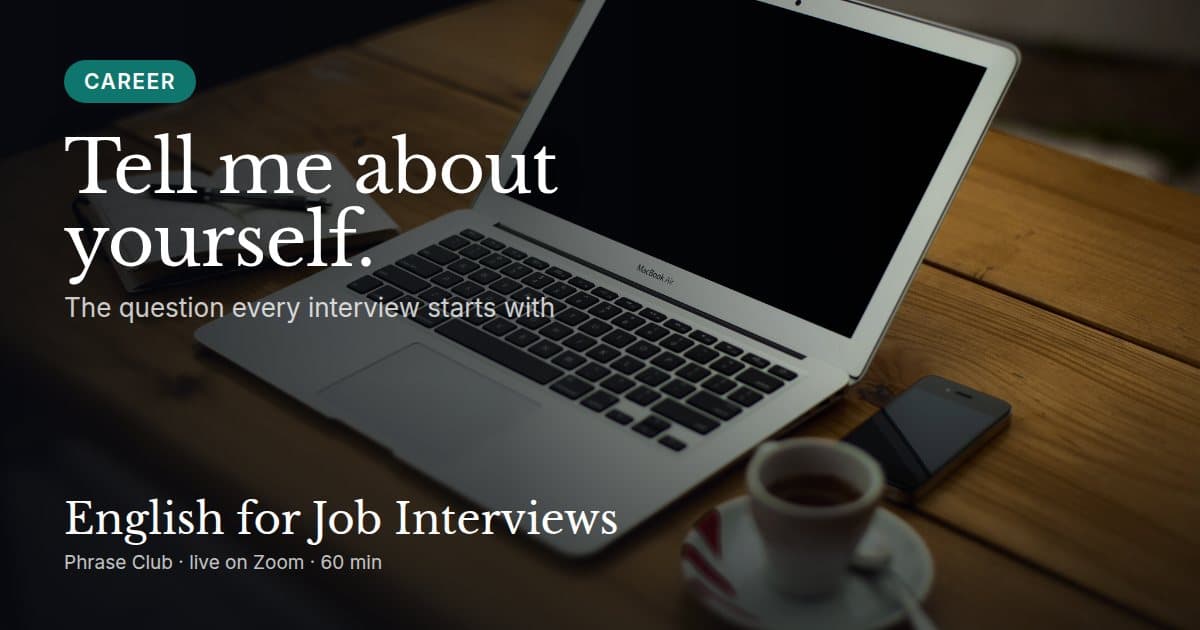
English for Job Interviews
A practical, live hour for beginners and elementary learners preparing for a job interview in English. The teacher speaks slowly and shows every phrase on screen. You will practise the small talk at the start, a short "tell me about yourself" answer, talking about your experience and strengths, answering the most common questions, asking your own questions and saying a professional thank-you, then try a mini mock interview in small groups.
After this hour you can
- Make polite small talk when you arrive and when you leave
- Give a short, clear answer to "Tell me about yourself"
- Talk about your experience and strengths with an example
- Answer common questions, including the "weakness" question
- Ask the interviewer good questions at the end
- Say thank you and write a short thank-you email
- 0′–5′
Welcome
Know how the class works and think about your own interview.
- 5′–12′
Arriving and small talk
Arrive, greet the interviewer and handle the first two minutes of small talk.
Hello, I'm Ana Nowak. I have an interview at ten.
say heh-LOH, aim AH-nuh NOH-vak. ai hav an IN-tuh-vyoo at TEN
What to say at reception when you arrive.
Nice to meet you.
say NAIS tuh MEET yoo
Say this when you meet the interviewer, with a smile and a short handshake.
+ 5 more on your phrase sheet
- 12′–20′
Tell me about yourself
Give a one-minute introduction: what you do now, what you did before and what you want next.
Tell me about yourself.
say TEL mee uh-BOWT yor-SELF
Often the first real question. They want about one minute: now, past, future.
I'm a … with five years of experience in …
say aim uh … with FAIV yeerz uv ik-SPEER-ee-uns in …
Start with who you are at work: "I'm a nurse with five years of experience in children's hospitals."
+ 6 more on your phrase sheet
- 20′–28′
Experience and strengths
Say what you are responsible for, name a strength and back it up with an example.
I'm responsible for …
say aim rih-SPON-sih-bul for …
Say what you do in your job: "I'm responsible for the hotel bookings."
I have experience with …
say ai hav ik-SPEER-ee-uns with …
"I have experience with Excel / with customers / with children."
+ 7 more on your phrase sheet
- 28′–36′
Common questions
Understand the most common interview questions and answer them with a simple frame.
Why do you want to work here?
say WAI duh yoo WONT tuh wurk HEER
They want to see you know the company. Answer: "I like your … and I want to …"
What is your biggest weakness?
say wot iz yor BIG-ist WEEK-nis
A classic question. Give a real but small weakness, and say what you do about it.
+ 7 more on your phrase sheet
- 36′–42′
Your questions
Ask the interviewer two good questions at the end.
Do you have any questions for us? – Yes, I do.
say doo yoo hav EN-ee KWES-chunz for us? – YES, ai DOO
The interviewer always asks this at the end. Always have two questions ready.
What does a typical day look like?
say wot duz uh TIP-ih-kul DAY luk laik
"What will I do every day in this job?"
+ 4 more on your phrase sheet
- 42′–47′
Goodbye and thank-you
Finish the interview politely and write a short thank-you email.
Thank you for your time.
say THANK yoo for yor TAIM
The standard polite ending of an interview.
I really enjoyed our conversation.
say ai REE-lee in-JOYD OW-uh kon-vuh-SAY-shun
A warm, professional thing to say at the end.
+ 4 more on your phrase sheet
- 47′–57′
Practice: the mock interview
Do a short mock interview from small talk to goodbye.
- 57′–60′
Recap and this week
Remember the key phrases and know what to practise before your interview.
Interview English is more formal than everyday English, but it does not need to be complicated: short, clear sentences with a few key phrases sound confident and professional. Interviewers care more about clear examples than perfect grammar, and they are used to accents. Today we learn ready-made "sentence frames" that you fill in with your own job, studies and skills.
- Zoom on a computer, tablet or phone
- A microphone; headphones with a mic are best
- Somewhere you are happy to speak out loud
- Pen and paper, if you like. No English needed.
Do I need to know any of the language already?
No. Every class is for complete beginners. We start from hello, and everything is explained in English. If you already know a little, it will be a good warm-up, but it will feel easy.
What happens in the hour?
A short welcome, then the sounds (or, for Japanese and Korean, a first look at the writing), greetings, introducing yourself, numbers to ten, ordering at a café and the phrases that get you out of trouble. Then you practise in small breakout rooms and we finish with a recap. Each class page shows the hour minute by minute.
Will I have to speak?
Yes, that is the point, but gently. Most of the time the whole class repeats together with microphones on, so nobody is singled out. Near the end you practise in breakout rooms of 2 or 3. Your camera is up to you.
How big are the classes?
At most 12 people, so everyone gets to speak and ask questions.
How much is a class?
One class is one payment, and you see the price before you pay. Nothing renews and there is no subscription.
Can I cancel or move my class?
Yes. Write to support@bunevents.com at least 24 hours before the start and we will refund you in full or move you to another time, whichever you prefer.