Photo: Bgag, CC0
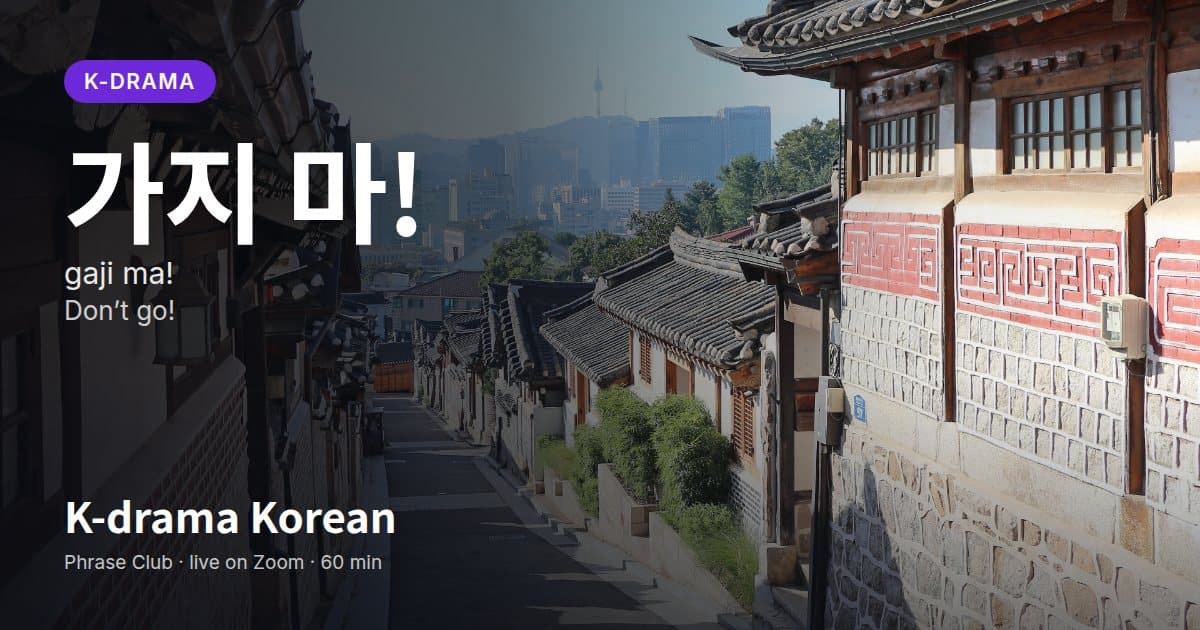
K-drama Korean: The Lines Every Fan Knows
A fun, live hour of Korean for K-drama fans who are complete beginners. You will read your first drama words in Hangul, then learn the lines you hear in every episode (괜찮아?, 미안해, 고마워, 가지 마, 진짜?, 어떡해, 아이고, 대박, 헐), the family titles (엄마, 아빠, 할머니, 오빠, 언니), a little aegyo, and the big one: banmal vs jondaenmal, casual vs polite Korean, so you know when drama speech would sound rude to a real person. Every phrase comes with romanization, so you do not need to read Hangul yet.
After this hour you can
- Read a few drama words in Hangul, block by block
- React like a drama character: 진짜?, 대박!, 헐, 어떡해, 아이고
- Understand the caring lines: 괜찮아?, 미안해, 고마워, 가지 마, 밥 먹었어?
- Switch drama banmal into polite Korean for real people
- Use family titles and know who calls whom 오빠, 언니, 형 and 누나
- Recognise aegyo and the cute, playful lines of drama couples
- 0′–5′
Welcome
Know how the class works and the big idea of the hour: drama Korean vs real-life Korean.
- 5′–11′
Hangul taster: drama words and drama food
See how letters stack into blocks and read a few words you see in every drama.
드라마
deurama
say deu-rah-mah
drama, TV series
사랑
sarang
say sah-rahng
love
+ 4 more on your phrase sheet
- 11′–18′
Reactions: 진짜?, 대박!, 헐, 어떡해
React like a drama character and know these are casual.
진짜?
jinjja?
say jeen-jjah?
Really?
대박!
daebak!
say deh-bahk!
Awesome! / No way! / Jackpot!
+ 6 more on your phrase sheet
- 18′–26′
Caring lines: 괜찮아?, 미안해, 가지 마
Understand and say the caring, apologising and pleading lines of every drama.
괜찮아? / 응, 괜찮아.
gwaenchana? / eung, gwaenchana.
say gwen-chah-nah? / eung, gwen-chah-nah.
Are you OK? / Yeah, I'm OK.
미안해
mianhae
say mee-ahn-heh
I'm sorry (casual)
+ 6 more on your phrase sheet
- 26′–33′
Banmal vs jondaenmal: when drama speech is rude
Turn casual drama lines into polite Korean and know when each is right.
반말 / 존댓말
banmal / jondaenmal
say bahn-mahl / john-den-mahl
casual speech / polite speech
괜찮아요?
gwaenchanayo?
say gwen-chah-nah-yoh?
Are you OK? (polite)
+ 6 more on your phrase sheet
- 33′–40′
Family titles: 엄마, 아빠, 오빠, 언니
Use the family titles and know who calls whom what.
엄마
eomma
say uhm-mah
mum
아빠
appa
say ahp-pah
dad
+ 7 more on your phrase sheet
- 40′–47′
Love lines and aegyo basics
Recognise the love lines and the playful, cute speech of drama couples.
사랑해
saranghae
say sah-rahng-heh
I love you (casual)
좋아해
joahae
say joh-ah-heh
I like you (casual)
+ 5 more on your phrase sheet
- 47′–57′
Practice: two takes of a drama scene
Perform a mini drama scene in banmal, then the same scene politely, as real strangers would.
- 57′–60′
Recap and this week
Remember the key lines and know what to listen for in your next episode.
Korean looks hard, but its alphabet, Hangul, was designed to be easy: 24 basic letters that stack into syllable blocks, and many people learn to sound out words in a few hours of practice. The most important thing for drama fans: Korean has speech levels. Drama characters mostly talk in 반말 (banmal), the casual speech of close friends, family and couples; with people you have just met, staff or anyone older, Koreans use 존댓말 (jondaenmal), polite speech that usually ends in 요. Korean has no strong word stress: say the syllables evenly.
- Zoom on a computer, tablet or phone
- A microphone; headphones with a mic are best
- Somewhere you are happy to speak out loud
- Pen and paper, if you like. No Korean needed.
Do I need to know any of the language already?
No. Every class is for complete beginners. We start from hello, and everything is explained in English. If you already know a little, it will be a good warm-up, but it will feel easy.
What happens in the hour?
A short welcome, then the sounds (or, for Japanese and Korean, a first look at the writing), greetings, introducing yourself, numbers to ten, ordering at a café and the phrases that get you out of trouble. Then you practise in small breakout rooms and we finish with a recap. Each class page shows the hour minute by minute.
Will I have to speak?
Yes, that is the point, but gently. Most of the time the whole class repeats together with microphones on, so nobody is singled out. Near the end you practise in breakout rooms of 2 or 3. Your camera is up to you.
How big are the classes?
At most 12 people, so everyone gets to speak and ask questions.
How much is a class?
One class is one payment, and you see the price before you pay. Nothing renews and there is no subscription.
Can I cancel or move my class?
Yes. Write to support@bunevents.com at least 24 hours before the start and we will refund you in full or move you to another time, whichever you prefer.