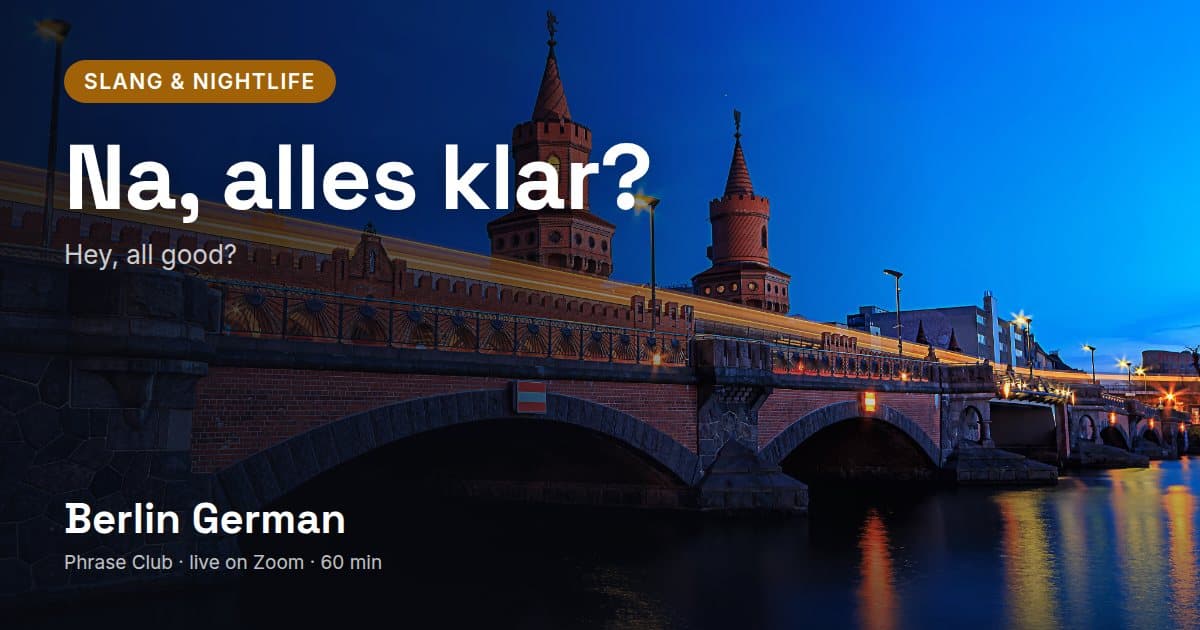
Photo: Alex Pj, CC BY 3.0
Berlin German: Slang & Nightlife
A fun, live hour of casual German for beginners heading to Berlin. You will learn the basic sounds and the relaxed "du" German young Berliners use, real Berlin words like Späti, Kiez, Schrippe and "Na?", everyday slang (with clear warnings about when not to use it), how to buy drinks at a Späti, make plans, talk politely at a club door, and ride the U-Bahn. Then you try a night out in a role-play with other students. No experience needed.
After this hour you can
- Greet people the Berlin way and chat using informal du
- Understand Berlin words and dialect like Späti, Kiez, ick and wat
- Use common slang, and know when it is too informal
- Buy drinks and snacks at a Späti and pay
- Make plans to meet friends: when, where, and "I'm in!"
- Talk politely at a club door and get around on the U-Bahn
- 0′–5′
Welcome
Know how the class works and what casual Berlin German sounds like.
- 5′–12′
Warm-up: hello in du-German
Greet someone casually, ask their name and where they are from, using du.
Hallo! / Hey!
say HAH-loh / HAI
Hello! / Hi!
Na?
say NAH? (voice goes up)
Hey, how's it going? (very casual)
+ 6 more on your phrase sheet
- 12′–19′
Berlin words
Understand Berlin dialect and the words every Berliner uses.
ick / icke
say ICK / ICK-eh
I (Berlin dialect for "ich")
Wat?
say VAHT
What? (Berlin for "Was?")
+ 6 more on your phrase sheet
- 19′–25′
Slang, with care
Understand and use common slang, and know which words are only for friends.
Alter!
say AHL-tuh
Dude! / Mate! / Wow! (very informal)
geil
say GILE (rhymes with "mile")
Awesome, amazing (very informal)
+ 5 more on your phrase sheet
- 25′–32′
At the Späti
Buy drinks and snacks, ask about card payment, and understand the bottle deposit.
Ein Bier, bitte.
say ain BEER, BIT-teh
A beer, please.
Eine Club-Mate, bitte.
say AI-neh KLUP-mah-teh, BIT-teh
A Club-Mate, please (a fizzy drink with caffeine, made from mate tea)
+ 6 more on your phrase sheet
- 32′–38′
Making plans
Suggest a plan, agree on a time and place, and say yes or "maybe later".
Was machst du heute Abend?
say vahs MAHKHST doo HOY-teh AH-bent
What are you doing tonight?
Hast du Lust auf …?
say hahst doo LOOST owf …
Do you feel like …? ("Hast du Lust auf ein Bier?")
+ 6 more on your phrase sheet
- 38′–43′
At the club door
Talk politely to the door staff and accept the answer, yes or no.
Guten Abend!
say GOO-ten AH-bent
Good evening!
Wie viele seid ihr?
say vee FEE-leh ZITE eer
How many of you are there?
+ 5 more on your phrase sheet
- 43′–48′
On the U-Bahn
Find the right line and direction, buy a ticket and understand the key announcements.
Welche Linie fährt nach …?
say VEL-kheh LEE-nee-eh FAIRT nahkh …
Which line goes to …?
Ist das die richtige Richtung?
say ist dahs dee RIKH-tee-geh RIKH-toong
Is this the right direction?
+ 5 more on your phrase sheet
- 48′–57′
Practice: a night out in Berlin
Make plans, buy a drink at a Späti and talk at the club door, using casual German.
- 57′–60′
Recap and this week
Remember the key phrases and know what to practise before your trip.
Berlin is relaxed and international, and among young people almost everyone uses informal "du" (you) instead of polite "Sie". Berliners also have their own dialect: "ick" for "ich", "wat" for "was", "dit" for "das", and a g that often becomes a y sound ("jut" for "gut"). You don't need to speak the dialect, but understanding it helps a lot. The slang today is real and common, but some of it is very informal, so each word comes with a note on when to use it and when not to. Standard German works everywhere; with officials, shop staff you don't know, and older people, use "Sie".
- Zoom on a computer, tablet or phone
- A microphone; headphones with a mic are best
- Somewhere you are happy to speak out loud
- Pen and paper, if you like. No German needed.
Do I need to know any of the language already?
No. Every class is for complete beginners. We start from hello, and everything is explained in English. If you already know a little, it will be a good warm-up, but it will feel easy.
What happens in the hour?
A short welcome, then the sounds (or, for Japanese and Korean, a first look at the writing), greetings, introducing yourself, numbers to ten, ordering at a café and the phrases that get you out of trouble. Then you practise in small breakout rooms and we finish with a recap. Each class page shows the hour minute by minute.
Will I have to speak?
Yes, that is the point, but gently. Most of the time the whole class repeats together with microphones on, so nobody is singled out. Near the end you practise in breakout rooms of 2 or 3. Your camera is up to you.
How big are the classes?
At most 12 people, so everyone gets to speak and ask questions.
How much is a class?
One class is one payment, and you see the price before you pay. Nothing renews and there is no subscription.
Can I cancel or move my class?
Yes. Write to support@bunevents.com at least 24 hours before the start and we will refund you in full or move you to another time, whichever you prefer.