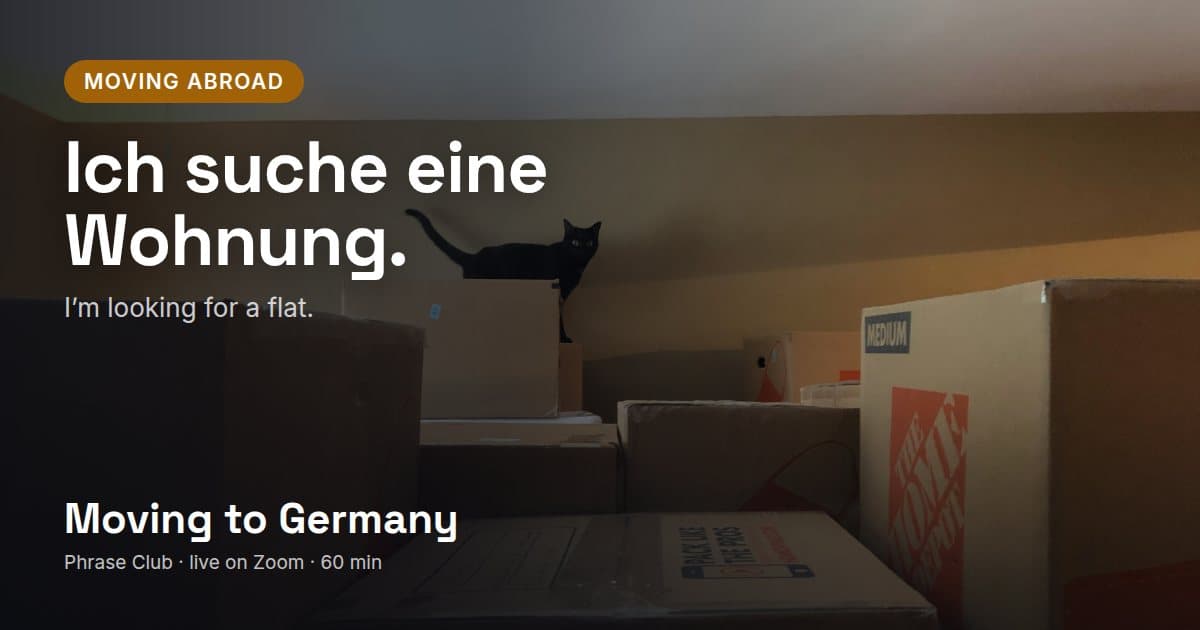
Photo: Paulo O from Halifax, Canada, CC BY 2.0
Moving to Germany: Survival German
A practical, live hour of German for complete beginners who are moving to Germany or have just arrived. You will learn the polite "Sie" German you need with officials, the key words for flat hunting (WG, Kaltmiete, Warmmiete, Besichtigung), what to say at the Bürgeramt for your Anmeldung, simple phrases for opening a bank account and getting a phone contract, how to make a doctor's appointment, and how to say hello to your new neighbours. Then you practise the Bürgeramt and a flat viewing in a role-play.
After this hour you can
- Speak politely with Sie and ask people to slow down, repeat or write it down
- Understand flat adverts and ask the right questions at a viewing
- Register your address at the Bürgeramt with the right documents
- Open a bank account and ask about a phone contract
- Make a doctor's appointment and say what is wrong
- Introduce yourself to your neighbours and ask about parcels
- 0′–5′
Welcome
Know how the class works and the steps of moving to Germany.
- 5′–12′
Warm-up: polite basics with Sie
Greet people politely and ask them to repeat, slow down or write it down.
Guten Tag!
say GOO-ten TAHK
Hello / Good day (polite)
Mein Name ist …
say main NAH-meh ist …
My name is …
+ 7 more on your phrase sheet
- 12′–20′
Flat hunting
Understand a flat advert and ask about price, availability and the viewing.
die Wohnung
say dee VOH-noong
The flat / apartment
die WG / das WG-Zimmer
say dee vay-GAY / dahs vay-GAY-tsim-muh
A shared flat / a room in a shared flat
+ 8 more on your phrase sheet
- 20′–27′
Registering your address: the Anmeldung
Book and attend your Anmeldung appointment with the right documents.
das Bürgeramt
say dahs BÜR-guh-ahmt
The citizens' office, where you register your address
die Anmeldung
say dee AHN-mel-doong
Registering your address
+ 7 more on your phrase sheet
- 27′–34′
Bank and phone
Open a bank account and ask about phone contracts, fees and cancellation.
Ich möchte ein Konto eröffnen.
say ikh MÖKH-teh ain KON-toh air-ÖFF-nen
I would like to open an account.
das Girokonto
say dahs ZHEE-roh-kon-toh
A current account (for everyday money and salary)
+ 6 more on your phrase sheet
- 34′–41′
At the doctor's
Make an appointment, answer the insurance question and say what is wrong.
Ich möchte einen Termin machen.
say ikh MÖKH-teh AI-nen tair-MEEN MAH-khen
I would like to make an appointment.
der Hausarzt / die Hausärztin
say dair HOWS-artst / dee HOWS-airts-tin
The family doctor, GP (man / woman)
+ 7 more on your phrase sheet
- 41′–47′
Meeting the neighbours
Introduce yourself to your neighbours, talk about parcels and know the house rules.
Guten Tag, ich bin neu hier.
say GOO-ten TAHK, ikh bin NOY heer
Hello, I'm new here.
Ich wohne im dritten Stock.
say ikh VOH-neh im DRIT-ten SHTOK
I live on the third floor.
+ 6 more on your phrase sheet
- 47′–57′
Practice: viewing and Bürgeramt
Ask about a flat at a viewing and register your address, using polite German.
- 57′–60′
Recap and this week
Remember the key phrases and know what to prepare before your appointments.
German is a close relative of English (Bank/bank, Telefon/telephone, Doktor/doctor), and it is read the way it is written once you know a few rules. Official German is full of long compound words like "Wohnungsgeberbestätigung", but they are just small words glued together, and you only need to recognise a handful. With officials, landlords, doctors and neighbours you don't know, always use the polite "Sie" form: it is expected, and it makes everything go more smoothly. Many offices use German only, so a few polite phrases help a lot.
- Zoom on a computer, tablet or phone
- A microphone; headphones with a mic are best
- Somewhere you are happy to speak out loud
- Pen and paper, if you like. No German needed.
Do I need to know any of the language already?
No. Every class is for complete beginners. We start from hello, and everything is explained in English. If you already know a little, it will be a good warm-up, but it will feel easy.
What happens in the hour?
A short welcome, then the sounds (or, for Japanese and Korean, a first look at the writing), greetings, introducing yourself, numbers to ten, ordering at a café and the phrases that get you out of trouble. Then you practise in small breakout rooms and we finish with a recap. Each class page shows the hour minute by minute.
Will I have to speak?
Yes, that is the point, but gently. Most of the time the whole class repeats together with microphones on, so nobody is singled out. Near the end you practise in breakout rooms of 2 or 3. Your camera is up to you.
How big are the classes?
At most 12 people, so everyone gets to speak and ask questions.
How much is a class?
One class is one payment, and you see the price before you pay. Nothing renews and there is no subscription.
Can I cancel or move my class?
Yes. Write to support@bunevents.com at least 24 hours before the start and we will refund you in full or move you to another time, whichever you prefer.