Photo: Asanagi, CC0
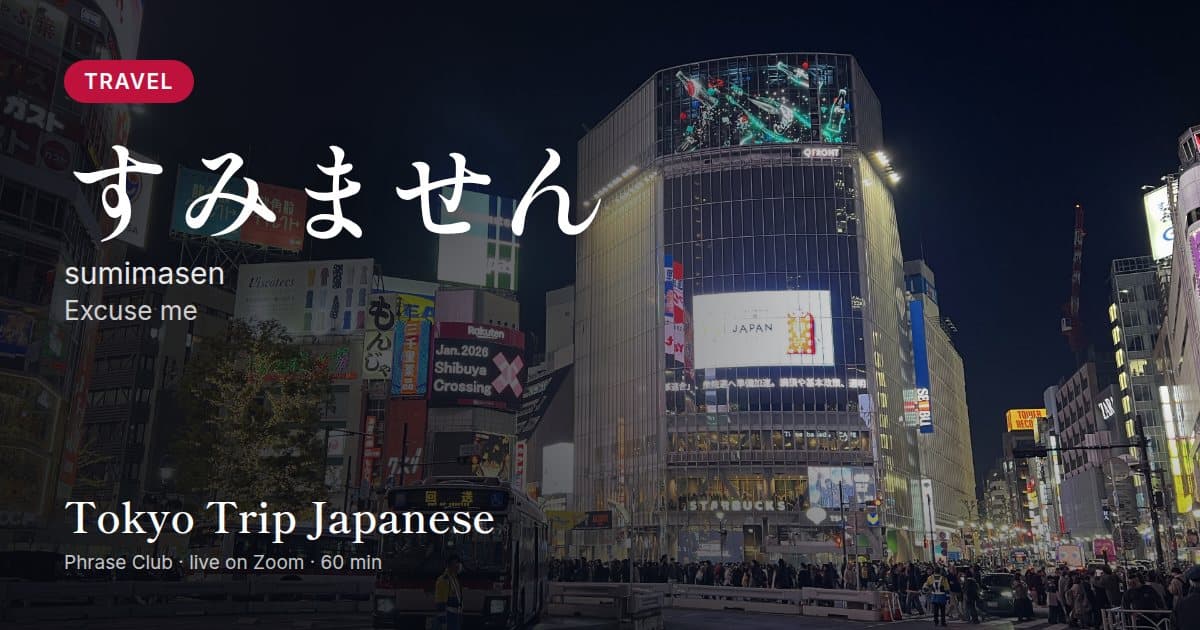
Tokyo Trip Japanese: Konbini, Trains and Ramen
A practical, live hour of Japanese for complete beginners planning a trip to Tokyo. You will read the most useful signs (exit, station, toilet), learn why すみません is the magic word, understand prices and the questions konbini staff ask, find your platform, use a ramen ticket machine, order in a restaurant and ask for directions when you get lost. Every phrase comes with romanization, so you do not need to read Japanese script yet.
After this hour you can
- Read a few key signs: 東京, 駅, 出口, 入口, トイレ
- Use すみません to get attention, apologise and say thanks
- Understand prices in yen and answer the konbini questions (bag? heat it up?)
- Ask where something is and whether a train goes to your stop
- Use a ramen ticket machine, order, pay and thank the staff
- Ask for directions and understand right, left and straight on
- 0′–5′
Welcome
Know how the class works and what Tokyo Japanese sounds like.
- 5′–11′
Sign taster: what you will see in Tokyo
Recognise the signs you need most: station, exit, entrance and toilet.
東京
Tōkyō
say toh-kyoh
Tokyo
駅
eki
say eh-kee
station
+ 5 more on your phrase sheet
- 11′–16′
Sumimasen: the magic word
Use すみません to get attention, apologise and thank, and say "no thanks" politely.
すみません。
sumimasen.
say soo-mee-mah-sen.
Excuse me / Sorry / Thank you for the trouble
ありがとうございます。
arigatō gozaimasu.
say ah-ree-gah-toh goh-zai-mahs.
Thank you (polite)
+ 4 more on your phrase sheet
- 16′–24′
Konbini: prices and the questions staff ask
Understand prices in yen and answer the bag, heating and chopsticks questions.
いち、に、さん、よん、ご
ichi, ni, san, yon, go
say ee-chee, nee, sahn, yohn, goh
1, 2, 3, 4, 5
ろく、なな、はち、きゅう、じゅう
roku, nana, hachi, kyū, jū
say roh-koo, nah-nah, hah-chee, kyoo, joo
6, 7, 8, 9, 10
+ 8 more on your phrase sheet
- 24′–31′
Trains: finding the platform
Ask where something is and check that a train goes to your stop.
___はどこですか?
___ wa doko desu ka?
say ___ wah doh-koh dess-kah?
Where is ___?
改札
kaisatsu
say kai-sah-tsoo
ticket gates
+ 7 more on your phrase sheet
- 31′–39′
Ramen shop and restaurant
Get seated, use a ticket machine, order, pay and thank the staff.
いらっしゃいませ!
irasshaimase!
say ee-rahs-shai-mah-seh!
Welcome! (staff, as you walk in)
何名様ですか?
nan-mei-sama desu ka?
say nahm-may-sah-mah dess-kah?
How many people? (staff)
+ 8 more on your phrase sheet
- 39′–47′
Getting lost and asking for directions
Ask for help, show where you want to go and understand simple directions.
すみません、道に迷いました。
sumimasen, michi ni mayoimashita.
say soo-mee-mah-sen, mee-chee nee mah-yoh-ee-mahsh-tah.
Excuse me, I'm lost.
ここに行きたいです。
koko ni ikitai desu.
say koh-koh nee ee-kee-tai dess.
I want to go here.
+ 7 more on your phrase sheet
- 47′–57′
Practice: a day in Tokyo
Get through a konbini, a train question and a ramen shop using only Japanese.
- 57′–60′
Recap and this week
Remember the key phrases and know what to practise before the trip.
Japanese pronunciation is friendly for English speakers: five clear vowels and few difficult sounds. Signs in Tokyo mix kanji (characters with meaning), hiragana and katakana, and many station signs also have English, so you only need a few characters to feel at home. Politeness is built into the grammar, and Tokyo service staff speak very polite, formulaic Japanese; the good news is that the same few questions come up again and again, and today we learn them. Japanese has pitch accent, not stress: keep every syllable about the same length.
- Zoom on a computer, tablet or phone
- A microphone; headphones with a mic are best
- Somewhere you are happy to speak out loud
- Pen and paper, if you like. No Japanese needed.
Do I need to know any of the language already?
No. Every class is for complete beginners. We start from hello, and everything is explained in English. If you already know a little, it will be a good warm-up, but it will feel easy.
What happens in the hour?
A short welcome, then the sounds (or, for Japanese and Korean, a first look at the writing), greetings, introducing yourself, numbers to ten, ordering at a café and the phrases that get you out of trouble. Then you practise in small breakout rooms and we finish with a recap. Each class page shows the hour minute by minute.
Will I have to speak?
Yes, that is the point, but gently. Most of the time the whole class repeats together with microphones on, so nobody is singled out. Near the end you practise in breakout rooms of 2 or 3. Your camera is up to you.
How big are the classes?
At most 12 people, so everyone gets to speak and ask questions.
How much is a class?
One class is one payment, and you see the price before you pay. Nothing renews and there is no subscription.
Can I cancel or move my class?
Yes. Write to support@bunevents.com at least 24 hours before the start and we will refund you in full or move you to another time, whichever you prefer.